
The Lucian Bathrooms Standard
Crafted with Precision,
Built to Last
A direct look at how we assess, build, and hold our standard — from the first meeting to final handover.
The First Meeting
The build starts before the job does.
The first meeting is not just about listening to what you want changed. While you talk, we are already reading the room properly.
We are looking at the walls, the floor, the plumbing routes, the toilet waste, the type of property, and what the room will realistically allow once everything is opened up. A floorboard floor already tells us we are dealing with joists and pipe routes. The toilet waste tells us whether the pan can move cleanly or whether it will need solving another way. The wall tells us whether a concealed mixer works there or whether the room needs to be built out first.
That is why we do not walk into a room thinking sink for sink, toilet for toilet, bath for bath. We are already looking at the layout and asking what the best version of that room can be.
Sometimes that means telling you straight away that your layout works. Sometimes it means explaining where the limitations are. And sometimes it means giving you better options you had not considered yet — a ledge built into the design properly, a false wall that hides pipework cleanly, storage where it actually helps, or a niche positioned where it makes sense in daily use.
We do not like bathrooms that feel compromised. We do not like visible workarounds where a cleaner solution was possible. So from the first meeting, we are already planning how the room can be built in a way that looks right, works properly, and makes sense once the job begins.
That same thinking runs through our Bathroom Renovations in North London, whether the project is a full refurbishment, a Wet Room, a Walk-In Shower, a Family Bathroom, or an En-Suite Bathroom.
The Plan
By the time you receive a price, the room is already mapped out.
Our quote is not a quick measure-up and a number at the bottom of the page. By the time you receive a price, the room has already been thought through properly.
We already know the likely wall types, the likely floor structure, what kind of ceiling work may be needed, what routes the plumbing will probably take, and what materials make sense for that particular room. Every bathroom is different, so every build is priced around what that room will actually need.
That means the price is based on how the room needs to be built, not just what is being replaced. We are already staging the work in our heads, already choosing systems, and already thinking through the order of works before the job even starts.
The same approach carries into Kitchen Renovations and Tiling Services too. The room still has to be understood properly before good work can begin.
Strip-Out & Assessment
We open the room properly before we decide what it needs.
Once the job starts, everything comes out. Strip-out is not just demolition. It is the point where assumptions stop and facts start.
Only once the room is opened up can we confirm the wall strategy, the floor strategy, the plumbing routes, the reinforcements, and the exact build route. That is also why we do not order materials before strip-out. Even when we already know the likely direction, the room still needs to show us exactly what it needs once it is opened.
If the floor needs more than new plywood, we say it clearly. If a wall needs a different system than first expected, we adjust properly. If the room reveals something that changes the method, we deal with it there and then, at the stage where it should be dealt with.
We do not create drama around discoveries, but we do not ignore them either. If something needs doing, it gets done at the right stage, for the right reason.
We do not build around assumptions. We open the room first and make decisions from what is actually there.
Building the Structure
The finish only works if the room is built properly first.
We always start from the floor. If it flexes, we strengthen it. Joists are doubled and bolted properly, noggings are added where needed, the level is checked, and the routes are planned before the floor is closed.
Plumbing is done on copper as standard, soldered properly, not run in plastic because it is quicker. First fix is laid out around the actual room and the actual suite, not guessed in rough positions and corrected later.
The walls are made flat, plumb, square, and strong enough for what they are carrying. If wall-hung units, mirrors, radiators, trays, baths, or any other fixing points need support, that support is built in before tiling starts. If a ceiling needs lowering, it is done properly as part of the build, not forced in later because the room was not planned well enough at the start.
This stage is where the room stops being an old bathroom and starts becoming the new one.
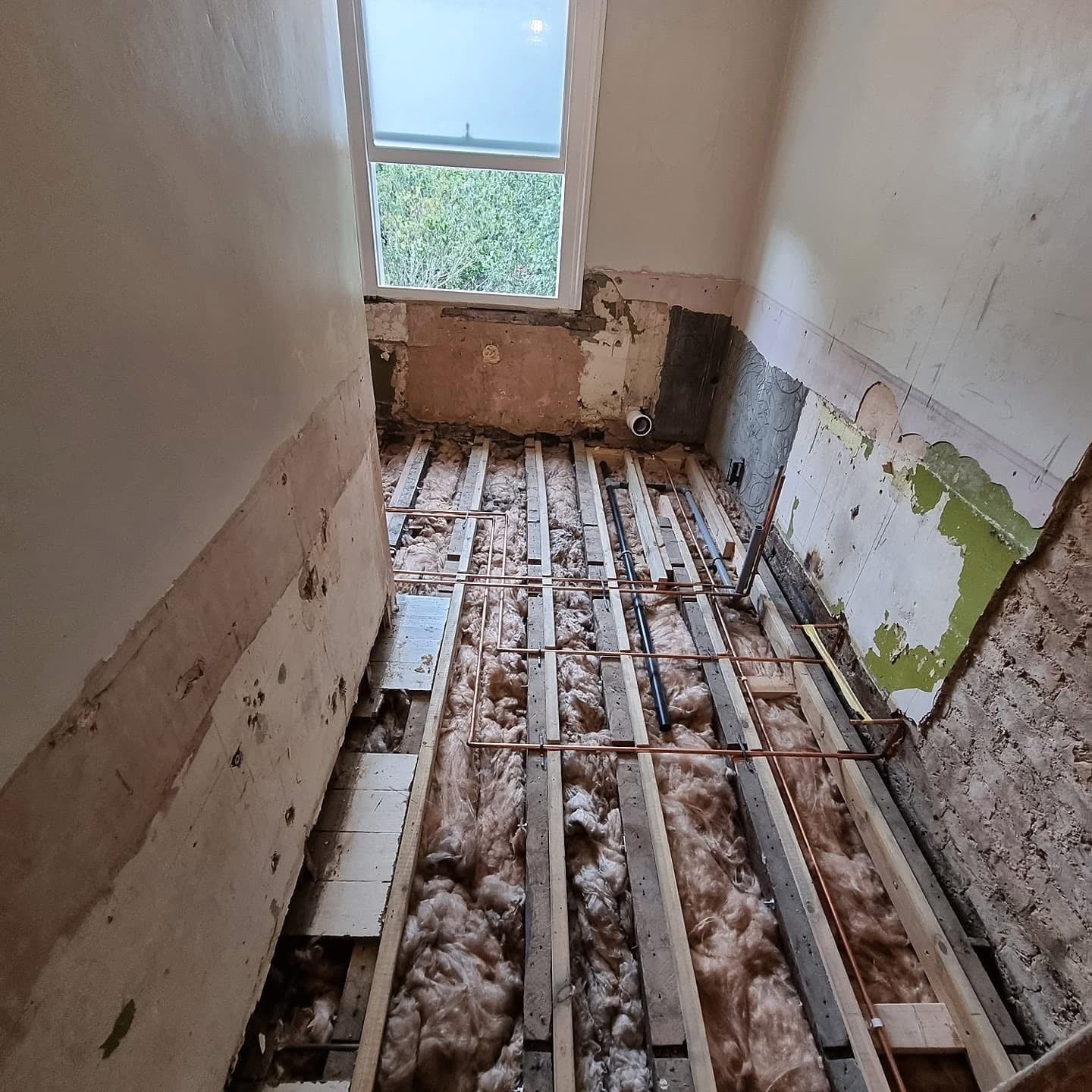
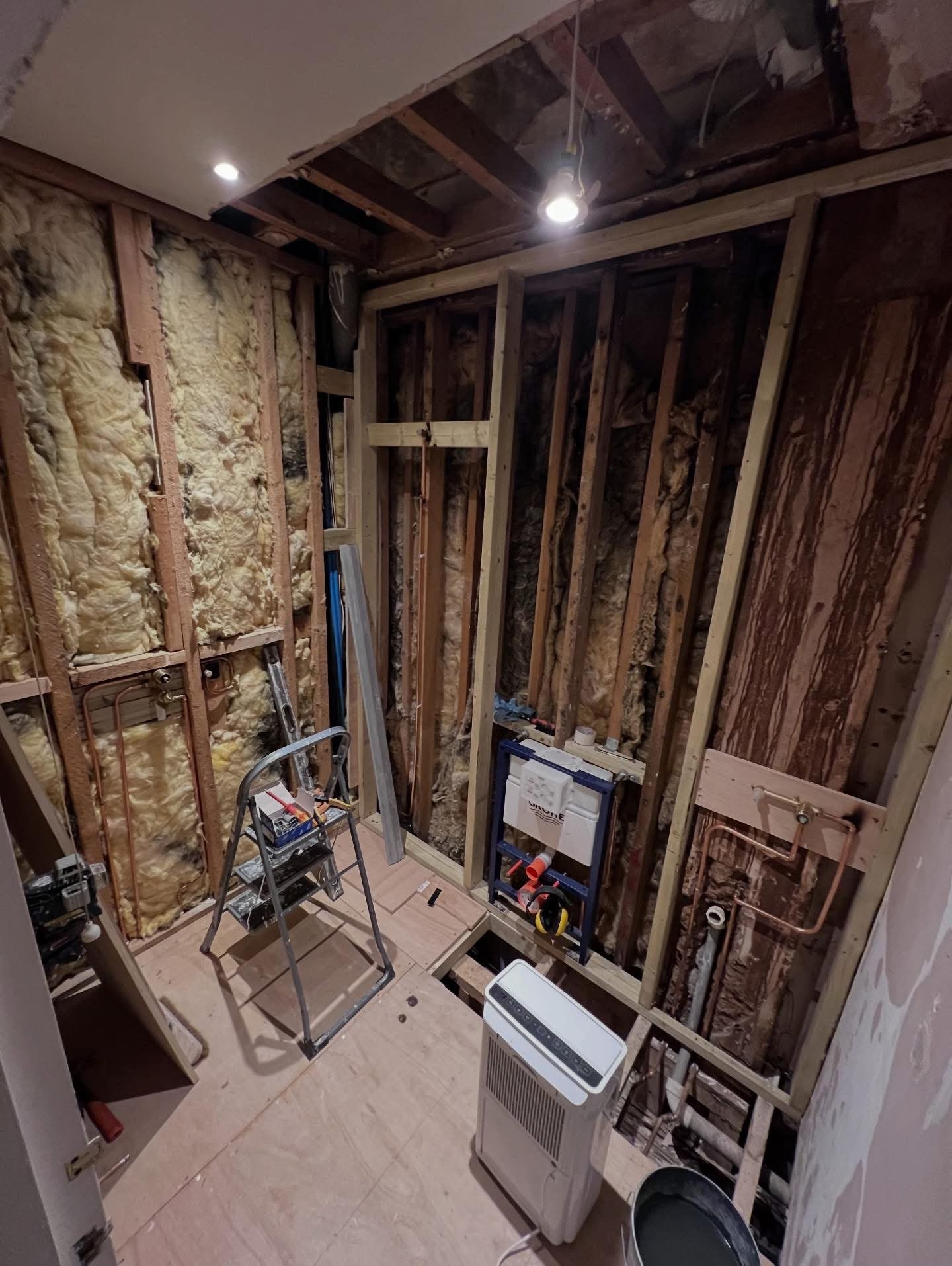
Second fix feels easy only when the hard thinking was done early.
Tile Layout
The tile layout is decided before the room is closed.
We do not wait until tiling starts to think about cuts, lines, and proportions. Mixer heights, niche positions, ledges, tray levels, bath heights, and where possible even ceiling heights are all considered with the tile layout in mind.
The goal is not to force the room into a textbook standard. The goal is to make the room read properly when it is finished. Full tiles where they matter. Cleaner lines through niches and ledges. Less visual noise. Fewer awkward cuts. Better balance across the whole room.
That thinking matters just as much on specialist Tiling Services as it does on full Bathroom Renovations in North London. Good tile layout is not luck on the day. It is planned into the build.
If the room needs a Wet Room, a Walk-In Shower, a Family Bathroom, or an En-Suite Bathroom, the same principle still applies. The room is built around the finished result, not left to chance once the tiles come out of the box.
The Standard
Some things are not a choice.
Our standard is not built on slogans. It is built on decisions that stay the same from job to job.
Waterproofing
Wet areas are waterproofed. Always. That is not an upgrade and it is not optional.
Copper Pipework
Our plumbing is done on copper and soldered properly. That is the standard.
Proper Preparation
We do not tile onto bad surfaces and hope the finish carries the room. The prep has to be right.
Reinforcement Where Needed
If floors, walls, baths, trays, mirrors, radiators, or fixing points need strengthening, they get strengthened.
Controlled Execution
We do not rush important stages just to move the job along faster. Good work still needs the right sequence and the right pace.
Clean Solutions
If something can be solved cleanly, that is the route we take. We do not accept messy compromises where a better answer exists.
Problem Solving
Hidden problems do not get easy solutions.
When a room is opened up, something can always appear that changes the original plan. A beam blocks a route. A waste lands where it should not. A wall needs more work than expected. A floor needs more support. That is real building work.
What we do not do is jump straight to the easiest visible compromise just because it gets the day moving again. We do not default to a box, a step, or an obvious patch if there is still a cleaner route available.
First, we look for the better answer. Change the tray orientation. Change the route. Adjust the item. Build it differently. Rethink the detail. Solve it in a way that protects the room instead of downgrading it.
Only if there is genuinely no better route do we accept a visible compromise. Problems are part of building. Lazy solutions do not have to be.
The easiest site solution is not always the right bathroom solution.
Client Communication
You are not kept in the dark while the room takes shape.
From day one to handover, the client knows what is happening. If something worth discussing comes up, we discuss it. Not with panic, and not with a problem dropped in your lap with no answer. We explain what it means and how it gets solved.
We also show the work as it happens. Floor reinforcement. First fix. Waterproofing. Bath installation. Tray installation. The parts that matter are not hidden and then forgotten. They are explained properly so you understand what has been done and why.
If the client is off site, they still stay involved. Important heights and positions still get confirmed. That matters because this is not hotel-standard fitting. It is a room built around the people who are going to use it.
That same straightforward communication carries across Kitchen Renovations and Tiling Services too. Clear work is easier to trust when it is explained clearly.
Trust is built during the job, not promised at the start.
The Handover
When it’s done, it’s done.
By handover, the room should not feel like a list of last-minute fixes. The toilet is flushed. The basin is filled and drained. The shower is run. The bath is checked. The seals are finished. The room is cleaned. The details are checked properly.
But handover is not where we discover whether the room works. It is where we confirm what has already been built properly.
Because the process has been transparent all the way through, clients are not standing there trying to work out what they missed. They already know how the room was built. They have seen the standard as it took shape. At that point, they are not looking for excuses. They are ready to use the room.
These standards shape every Bathroom Renovation in North London we take on, whether the project is a Wet Room, a Walk-In Shower, a Family Bathroom, or an En-Suite Bathroom. The same approach also carries into our Kitchen Renovations and Tiling Services.